Thursday, January 12, 2012

Romney, income inequality, and our deep seated jealousy

This morning on the Today Show, Mitt Romney told Matt Lauer that the problem of wealth inequality is not inherent unfairness of a flawed, biased system, but petty jealousy of the "unsuccessful." Lauer questioned Romney's usage of the word "envy" when addressing those who question the policies of Wall Street or the disproportionate distribution of wealth
"You know, I think it’s about envy. I think it’s about class warfare. When you have a president encouraging the idea of dividing America based on the 99 percent versus one percent — and those people who have been most successful will be in the one percent — you have opened up a whole new wave of approach in this country which is entirely inconsistent with the concept of one nation under God. The American people, I believe in the final analysis, will reject it."
As the GOP's presumptive nominee for president (someone at MSNBC said the "Romin-ee" - you're welcome), it is more than a little concerning that he would so forcefully insist that such discussions are for "quiet rooms" and abstractions, rather than something that should be brought to the attention of the American people. In fact, the conflict between rich and poor is in the consciousness of the nation already, whether Gov. Romney likes it or not. A new Pew survey out today shows that a full two-thirds of Americans perceive the social tensions caused by income inequality as "very strong" or "strong."

Apart from his denial of the blatantly obvious, what most troubles me about Romney's statement is that he believes that questioning systems which give power to the very few while making all others beholden to such a system is inconsistent with the nature of God. As Christians, we can see God through the witness of Christ's life on earth - one of confronting the Temple structure when it concerned itself with promoting its own power rather than caring for those in need. These were and are the 99% to which Mitt Romney seems so indifferent.

As the GOP candidates move through the primaries, striving for the title of most evangelical, we need to continue to remind them that Christianity calls for the care of the least among us. Now that is evangelism.


Wednesday, January 4, 2012

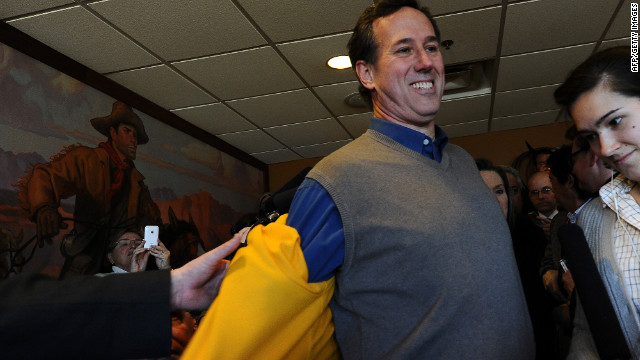
"They Are Powerful Garments."

From cnn.com


Just food for thought here:
The 2008 Canadian Federal Election will probably be remembered most for the blue sweater that Prime Minister Stephen Harper wore in a series of commercials that Reason Partners created.
The campaign was created to address the political opposition and media portrayal of Mr. Harper being “scary, cold and aloof” and at the same time attract more female votes.
With most political advertising these days, the emphasis is on defaming your opponent, often using the most unscrupulous means available.
We took the opposite approach by ignoring the opposition altogether and focusing instead on the truth and reality of Prime Minister Harper’s devotion to his family and his overall ideals, which are largely shared by most Canadians.
An optimistic approach and vision for the country.
The series of commercials worked right from the beginning, as the idea went massively viral.
It was mentioned in a pop song by the Barenaked Ladies, Billy Talent and K-OS. It was lampooned by comedians on and off the air. It was written about by fashion consultants. There were popular YouTube parodies. Not to mention, that it dwarfed all the other political parties ads combined on YouTube. It directly affected the sales of sweater vests in Canada. And it was the reference point for most media coverage during the election, including the NY Times and LA times.
It was integrated everywhere and into everything, including the Prime Minister’s campaign jet, nick-named the ‘Sweater Vest Jet’ by the media.
Perhaps the most memorable line during the English language debate was when the NDP’s Jack Layton said, “Where’s your platform Mr. Harper? Under the sweater?” Funny. But even funnier, as the CBC’s Rosemary Barton noted later in the campaign, “Jack Layton is now wearing a blue sweater.” And that, “Layton, pushing his bid to be Prime Minister this time round, is actually taking a page from the PM’s playbook. After a week away, one wonders if a sweater will ever just be a sweater again.” It was also noted that the Liberals, Stephane Dion and the Green Party’s Elizabeth May followed suit, err, sweater vest, as they both started wearing one in their respective party’s colour.
The Conservatives won the election. And for the first time, more women voted Conservative than Liberal. The Conservatives also had the best percentage gain in the popular vote versus the competition.
-Reason Partners
The quote in the title is from a friend of mine who wishes to remain nameless because he works for the man.

-Tim


Friday, December 16, 2011

Mitt recognizes faulty bootstraps, changes entire political philosophy

Sike! Gov. Romney still believes social safety nets are for the illusive "poor", definitely not for him or anyone he ever came in contact with before he entered politics. BUT! During the debate in Sioux City last night, Romney threw out this jab at President Obama:
"I think the president is going to ... go after me and say, 'You know, in businesses that you've invested in, they didn't all succeed. Some failed. Some laid people off. And he'll be absolutely right.' But if you look at all the businesses we invested in, over a hundred different businesses, they added tens of thousands of jobs. In the real world that the president has not lived in -- I actually think he doesn't understand that: that not every business succeeds, that not every entrepreneur is lucky enough to do as well as the entrepreneurs that I described ... I myself have had the chance of leading four different organizations. Each of those was highly successful, in part because of hard work, in part because of good luck.
As Liz Lemon might say, "What the what?" Hard work is only part of the #winning equation? He goes on to point out the president's handling of the GM bailout resulted in the closing of factories to save the company, which is what Romney did in his business pre-politics life, which is why the president doesn't understand economics? That part doesn't really matter (or make a lot of sense). What matters is that he recognized that sometimes, you can try your darnedest, and fail. Sometimes, you tug on your bootstraps, at they just pull right off.

As Christians, we can see the causes for such a footwear malfunction: systems of injustice and oppression which give all the "luck" to some people, at the cost of keeping others chronically in debt, jobless, and homeless. Jesus knew this, too. How could the people he healed even begin to live a life of integrity when the religious institution and the Roman Empire thrived off their required submission? We are compelled to respond as Jesus responded, to heal the individual and the community, to extend humanity to people in every capacity of life.

We live in a country where success is a commodity, and luck a privilege. While Mitt Romney might have accidentally stumbled upon inequality, he only scratched the surface of disenfranchisement in the United States. There is a reason some people have all the luck.

Wednesday, December 14, 2011

Theology <-> Politics

I need not discredit philosophy by laborious criticism of its arguments.  It will suffice if I show that as a matter of history it fails to prove its pretension to be "objectively" convincing.  In fact, philosophy does so fail.  It does not banish differences; it founds schools and sects just as feeling does.  I believe, in fact, that the logical reason of man operates in this field of divinity exactly as it has always operated in love, or in patriotism, or in politics, or in an other of the wider affairs of life, which our passions or our mystical intuitions fix our beliefs beforehand.  It finds arguments for our conviction, for indeed it has to find them.  It amplifies and defines our faith, and dignifies it and lends it words and plausibility.  It hardly ever engenders it; it cannot now secure it.
-William James, The Varieties of Religious Experience
I'd just as soon argue that theology, too often, does much of the same.  So back to my age old question: Does our theology inform our politics, or does it merely serve to, as James puts it, find arguments for our convictions?

-Tim

Sunday, December 11, 2011

Who is spreading the "religion is private" rumor, and how can I stop it?

Whenever I come across someone opining on the question of religion in America, I'm interested, because I myself get pretty opine-y about that very subject. And when it comes up in a national media outlet, say, the New York Times, I get my hopes up, because the Grey Lady has standards. However, I was fairly disappointed this morning when I read Eric Weiner's opinion article, Americans: Undecided About God?.

Weiner invoked the growing "spiritual, but not religious" (which is like nails on a chalkboard for this writer) contingency in the United States, blaming religion's effort to influence the political sphere as the catalyst for the trend.
"Their idea is that we’ve mixed politics and religion so completely that many simply opt out of both; apparently they are reluctant to claim a religious affiliation because they don’t want the political one that comes along with it."
I'm not sure I can swallow such a hypothesis. People are turned off by "institutional religion" (*see "spiritual, but not religious") for many reasons: hypocrisy, perceived exclusions, rigidness, promotion of antiquated practices, etc. That a specific denomination (as it seems Weiner is actually speaking of, rather than Christianity, or any other religion for that matter, as a whole) supports certain public policy is an outgrowth of a particular understanding of theology. No religion exists neatly packaged apart from human existence. Teachings compel concrete responses. But Weiner seems to long for a more sterilized understanding of God:
"Religion and politics, though often spoken about in the same breath, are, of course, fundamentally different. Politics is, by definition, a public activity. Though religion contains large public components, it is at core a personal affair... There lies the problem: how to talk about the private nature of religion publicly."
This guy has traveled extensively as a correspondent for NPR, won a Peabody award, and written a book about finding God, and yet he still states rather cavalierly something at which a first semester seminary student would gawk. Religion is a private affair?! Nothing could be further from the truth. Christianity (the only religion on which I can speak with any sense of authority) introduces a way to live in a community that reflects God's mercy and grace. John Wesley, the founder of Methodism (as emphasized by Dr. Barry Bryant) spoke of piety, the love of God, and mercy, the love of neighbor, as twin components of the Christian faith. You cannot love God without extending compassion and justice to world around you. Whether Weiner likes it or not, religion is public.

He ends his article waxing poetically about a religion for the non-religious, yearning for a "Steve Jobs of religion" who can "invent a new way of being religious." Well, Mr. Weiner, the individualistic fulfillment you crave exists within the confines of modern consumerism and capitalism, but you are correct in assessing that you won't find it in the Bible, or most any religious text. I feel as though you might be looking in the wrong places (read: the television) for the religion you seek. That new way of being religious exists around you, in churches, shelters, agencies, seminaries, and many other places where people are attempting to live in the world as an expression of God's love. And as it turns out, that way of being religious is not new at all.